If you want to keep your artificial plants from fading after 3 months, you need to understand exactly what causes that fading in the first place—and how to fight it. From the impact of harsh UV rays to the quality of materials used, every factor counts. In this quick guide, you’ll discover proven strategies and essential tips to guarantee your artificial plants maintain their vibrant look long-term, no matter the environment. Ready to stop your faux greenery from losing its charm? Let’s get into how to make that happen!
Why Do Artificial Plants Fade? Understanding the Root Causes
Investing in artificial greenery is about achieving that “Keep Green Forever Fresh” look without the maintenance of live botany. However, seeing your investment turn blue or gray within a few months is a common frustration. To prevent this, you must first understand the enemies of artificial foliage.
The Role of UV Exposure and Solar Radiation
The primary culprit behind fading is ultraviolet (UV) radiation. Even if your fade artificial plants are placed indoors near a window, UV rays can penetrate glass and attack the chemical bonds in the dyes used to color the leaves.
- Photodegradation: UV light breaks down the chromophores (the part of the molecule responsible for color), causing the vibrant greens to bleach out.
- Intensity Matters: Direct sunlight accelerates this process significantly compared to indirect light.
- Spectrum Impact: It isn’t just visible light; the invisible UV spectrum does the most damage to untreated synthetic materials.
Material Quality: Why Some Fabrics Fade Faster Than Others
Not all artificial plants are manufactured equally. The longevity of the color is directly tied to the raw materials used during production.
- Surface-Dyed vs. Infused: Cheaper silk or fabric plants often have color sprayed onto the surface. This layer is thin and vulnerable.
- Polymer Quality: High-quality options utilize premium PE (Polyethylene) or PVC. In superior manufacturing, color pigments and UV inhibitors are mixed directly into the raw material before molding.
💡 Professional Insight: The “1-Meter Test”
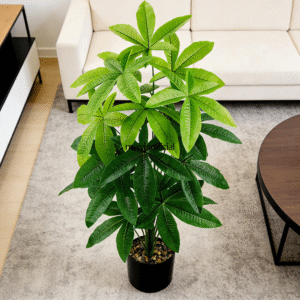
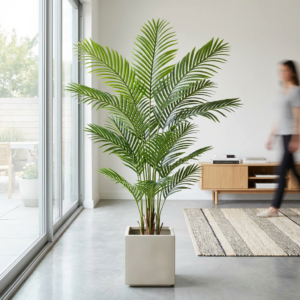
In high-end interior design, the “1-meter test” is where quality is truly revealed. If a guest can tell a plant is artificial from just a step away, the design loses its impact. True realism depends on mimicking the organic “fleshy” feel and matte finish of a living leaf—removing the unnatural plastic shine that often ruins commercial spaces. This is the hallmark of Real Touch Technology.
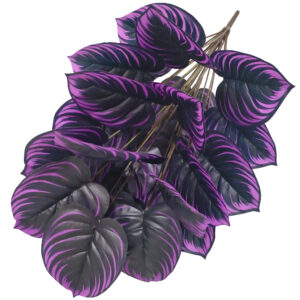
🎥 Close-up: See the “Real Touch” Texture in Action
Notice how the veins and matte surface respond to light—just like a natural leaf.
💡 Expert View: Why Texture Matters
In high-end interior design, the “1-meter test” is where quality is truly revealed. True realism depends on mimicking the organic “fleshy” feel and matte finish of a living leaf—removing the unnatural plastic shine. This is the hallmark of Real Touch Technology: absorbing light like biology, not reflecting it like plastic.
🎥 Close-up Look: Observe how the matte surface and veins react to light.
Environmental Stressors: Heat, Rain, and Pollutants
While the sun is the main antagonist, other environmental factors conspire to dull your greenery.
- Thermal Expansion: Extreme heat causes plastic materials to expand and contract, potentially causing micro-cracks in surface coatings.
- Moisture Damage: For outdoor applications, rain and humidity can wash away cheap, non-waterproof dyes.
- Pollution and Dust: A buildup of grime creates a layer that can trap heat, accelerating chemical breakdown.
Selecting UV-Rated Artificial Plants for Long-Term Durability
If you want to know how artificial plants can be guaranteed not to fade after 3 months, it all starts with the selection process. I always tell my clients that you can’t expect an indoor silk plant to survive a Texas summer.
The Difference Between Indoor and Outdoor-Rated Greenery
| Feature | Indoor-Rated Plants | Outdoor-Rated (UV-Rated) |
|---|---|---|
| Material | Silk, thin polyester, latex | High-density polyethylene (PE) |
| UV Resistance | None (will fade in 30 days) | Infused UV inhibitors (guaranteed for years) |
| Durability | Fragile; strictly for aesthetics | All-weather resistant |
Identifying Inherently UV-Protected (IUV) Materials
To ensure your investment lasts, look for Inherently UV-Protected (IUV) materials. This means the UV-resistant chemicals are mixed directly into the resin during the manufacturing process. IUV technology ensures that even when the top layer of plastic eventually wears, the color underneath remains the same.
Why Commercial-Grade Polyethylene Lasts Longer
In my experience, commercial-grade Polyethylene (PE) is the gold standard for long-term color retention. Unlike cheaper PVC, PE is more flexible and doesn’t become brittle after a few months in the sun.
Proven Strategies to Prevent Fading After 3 Months
Keeping your faux greenery looking vibrant isn’t just about luck; it’s about proactive care. To ensure your investment doesn’t fade artificial plants prematurely, you need a solid game plan.
Applying UV-Resistant Protectant Sprays
If your plants are exposed to harsh sunlight, an aftermarket UV spray acts like sunscreen for your foliage. While high-quality manufacturing integrates UV inhibitors, a topical spray adds a sacrificial layer of protection.
Strategic Placement and Utilizing Natural Shade
- Use Overhangs: Place pots under porch eaves or awnings.
- Shadow Play: Position plants in the shadow of larger structures during peak UV hours (10 AM to 2 PM).
Rotating Your Plants to Ensure Even Exposure
Static placement leads to uneven wear. To prevent a two-toned look, rotate your planters 180 degrees once a month. Many premium varieties, like our Fiddle Leaf Figs, feature a built-in adjustable steel wire within the stems, allowing you to reshape the foliage easily after rotation.
Essential Maintenance to Preserve Color and Vibrancy
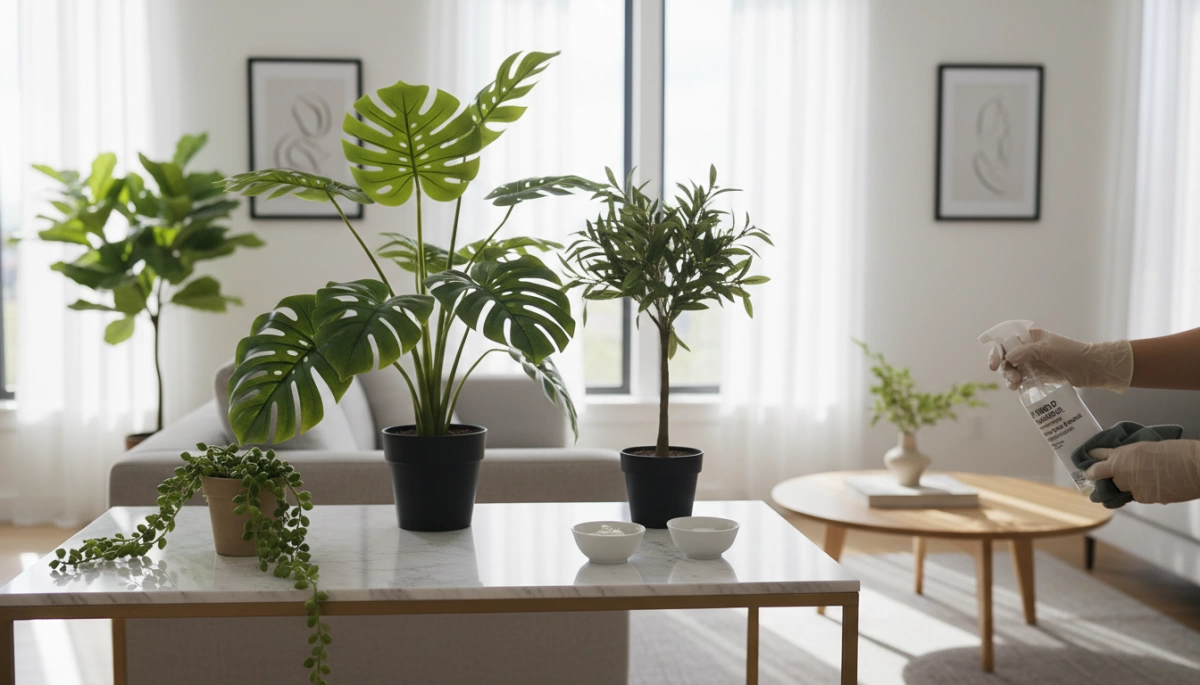
How to Clean Outdoor Artificial Foliage Safely
- Gentle Dusting: A simple feather duster works wonders on intricate leaves.
- Water Rinse: A gentle spray with a garden hose removes pollen and dirt.
- Mild Soap Solution: Use warm water and a drop of dish soap for stubborn grime.
Best Artificial Plant Varieties for High-Sun Environments
When designing outdoor spaces in high-heat areas, you have to pick varieties specifically engineered for high-intensity light. If the leaf feels like “fabric,” keep it inside. If it feels like “supple plastic,” it’s ready for the sun.
Durable Artificial Hedges and Privacy Screens
For large-scale installations, high-density polyethylene (HDPE) is the top recommendation. These are molded with color pigments mixed directly into the plastic, making them much harder to bleach.
How we support you:
🌿 Performance: Low maintenance, no watering, no seasonal damage.
🛡️ Safety: Fire Retardant & UV Resistance options to meet strict commercial codes.
🏭 Capability: OEM/ODM custom designs with Flexible MOQ supporting projects of all scales.
Just a clean, elegant, long-lasting solution designed to elevate your space.
If you are considering landscaping, upgrading residential or commercial real estate, please feel free to connect or message me for a consultation. 🤝