

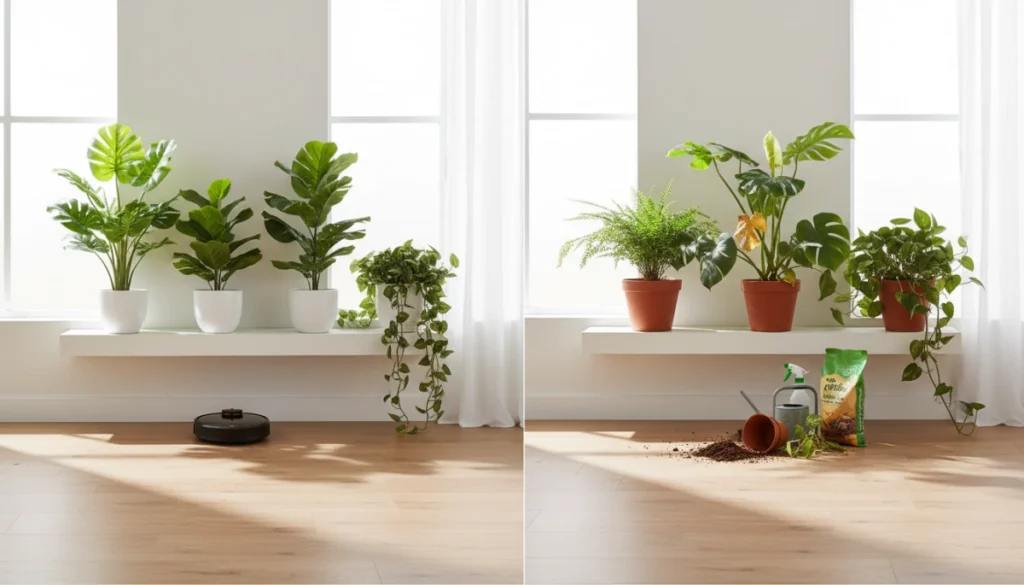
You might already feel the pressure to turn your home or office into a living “urban jungle”—a trend driven by the desire for biophilic design and connection to nature.
But what happens when the leaves turn brown, the water leaks, and the bugs move in? As one Chicago sales manager who travels 3 weeks a month put it: “Personally I don’t have the time or energy to take care of real plants, but I get depressed if there’s not enough greenery around, so fake plants keep me sane.”
The truth is, plant parent burnout is real—and it’s a sentiment shared by thousands of homeowners who’ve faced the same struggles.
You aren’t alone in wondering: Why do people dislike live plants? It isn’t about hating nature; it is about the stress of low maintenance expectations clashing with real-world demands, the mess of soil, and the guilt of watching expensive greenery wither. A Seattle teacher living in a basement apartment summed it up perfectly: “Our home has deep porches front and back and gets basically no direct light… it’s a tiny pool of viable candidates for live plants.”
However, one major fear stops people from making the switch:
Do artificial plants make the environment look tacky and ugly?
If you choose the wrong materials, the answer is yes. But if you understand modern manufacturing, the answer is a definitive no—as a Berkeley plant biologist with a Master’s in botany discovered: “I have a few fake ones from IKEA… one friend who was really outspoken about hating fake plants… complimented my fake ones.”
In this guide, I’m going to break down exactly why high-end interiors are switching to faux foliage, and how you can style botanically accurate greenery that looks indistinguishable from the real thing.
Let’s dive right in.
Why The “Green Thumb” Struggle Is Real
Let’s be honest—keeping nature alive indoors is often much harder than social media makes it look. Many homeowners every day who love the concept of biophilic design but are completely exhausted by the reality of maintaining it. The “green thumb” isn’t just a talent; it’s a part-time job. A Portland graphic designer and urban gardener put it best: “There is a sense of calmness when you care for plants, but the stress of keeping them alive takes away from that joy for most people.”
Understanding Maintenance Fatigue
The mental load of indoor gardening is real. It isn’t just about pouring water into a pot once a week; it is a constant cycle of monitoring humidity, adjusting for seasonal light changes, and fertilizing. This leads to plant parent burnout, where the joy of greenery is replaced by the guilt of watching expensive plants slowly wither because you missed a watering schedule during a busy work week. A freelance photographer who travels frequently echoed this: “I travel a lot and have had disappointing luck with house-sitters and self-watering devices—live plants just don’t fit my lifestyle.”
The Unglamorous Reality: Pests and Mess
One of the biggest reasons people dislike live plants is the biological baggage they bring into a clean home. When you bring organic soil inside, you are inviting an ecosystem that doesn’t always stay in the pot—something a Miami IT professional with asthma knows all too well: “Real plants host mold, fungi, and insects. They increase indoor humidity, promoting growth of molds and fungus in the home, which triggers my allergies nonstop.”
- Pest Infestations: Dealing with fungus gnats buzzing around your morning coffee or spider mites webbing up your Fiddle Leaf Fig is a nightmare. A Nashville homeowner ranted about the same issue: “I had to throw out a $150 Fiddle Leaf Fig because of spider mites—never again.”
- Mold and Fungus: Overwatering often leads to root rot and moldy soil, which can trigger allergies and create unpleasant odors.
- Messy upkeep: Dropping leaves, leaking drainage trays, and spilled dirt are constant cleaning hazards. A Dallas single mom with two young kids said: “Real plants mean constant cleanup—between the dirt and the leaves, I was spending hours every week just tidying up after them.”
Pet and Child Safety Risks
If you have a cat, dog, or toddler, live plants can be a serious liability. Many trending plants, such as Peace Lilies, Philodendrons, and Sago Palms, are highly toxic if ingested. Finding truly pet safe greenery that is also aesthetically pleasing restricts your design choices significantly. For many families, the risk of an emergency vet visit just isn’t worth the aesthetic benefit—an Austin vet technician with two cats explained: “I like [artificial plants] because I have a cat. I can’t risk her chewing on toxic leaves and ending up at the clinic.” Keer had a similar experience. “Common live plants like lilies, pothos, and philodendrons are toxic to pets, making artificial plants a safer choice for pet-owning families—who don’t want to risk their beloved pets’ health”.
Environmental Limitations
Most modern homes simply aren’t built like greenhouses. We have windowless bathrooms, dark hallways, and corners that never see the sun. While some low light indoor plants exist, they rarely achieve the lush, vibrant growth we see in magazines. Trying to force a sun-loving plant to survive in a dim room usually results in a leggy, struggling plant that detracts from your decor rather than enhancing it. A Boston software engineer summed up this frustration: “Some [plants] need more light than I can provide inside my home so I just buy the faux foliage for the places where they get no lights.”
Do Artificial Plants Look Tacky? The Honest Truth
Let’s be real. When people ask, “Do artificial plants make the environment look tacky and ugly?“, they are usually picturing those shiny, neon-green plastic monstrosities from the 90s. But the industry has shifted massively. There is a night-and-day difference between cheap dollar-store decor and manufacturing grade quality botanicals designed for luxury interiors. As an industry insider, I can tell you that modern production focuses on hyper-realism that cheap plastic just can’t touch—and a Los Angeles fashion blogger confirmed: “These aren’t your grandma’s Woolworth silk flowers—no one can tell they are fake.”
The Evolution of Faux Foliage
We have moved far beyond the days of fraying silk edges. Today’s faux foliage utilizes Real touch technology and advanced 3D printing to replicate the exact texture, vein structure, and weight of natural leaves. For instance, our artificial simulated eucalyptus camellia captures that specific waxy, cool-to-the-touch feel of living greenery. This technological leap allows us to create permanent botanicals that fool even the sharpest eyes, making the “fake” look a thing of the past. A Detroit grad student who uses IKEA’s Fejka line said: “The highly realistic artificial plants from IKEA look so real, even plant lovers can’t tell the difference.”
Botanical Accuracy through Imperfection
The secret to avoiding the “tacky” label is botanical accuracy, and that lies in imperfection. Nature isn’t perfectly symmetrical, and neither are high-end artificial plants—something a Chicago interior designer swears by: “1/3 of my plants are fake. They’re just good ones and tucked into corners / behind real ones to add filler so you don’t really notice them.”
- Natural Asymmetry: We mimic the irregular growth patterns and branch deviations found in nature.
- Color Variation: Leaves feature gradients, sun-faded tips, and even slight “blemishes” to avoid that uniform, plastic look.
- Textural Depth: Bark and stems are often molded from real samples to ensure the silhouette is organic.
Design Consistency
Nothing kills a room’s vibe faster than a brown, wilting plant in the corner. A pristine faux plant provides consistent, lush visuals year-round without the “ugly phase” of live gardening. Whether it’s a delicate centerpiece or a large-scale artificial Boston fern wall landscaping feature, the aesthetic remains polished and intentional. This consistency is why top designers prefer high-quality fauxs—they guarantee the look stays exactly as planned, indefinitely. A Phoenix home stager added: “I use permanent botanicals in every staging project because they never wilt, and they make the space look vibrant 24/7.”
Live vs. Artificial Plants: A Real Comparison
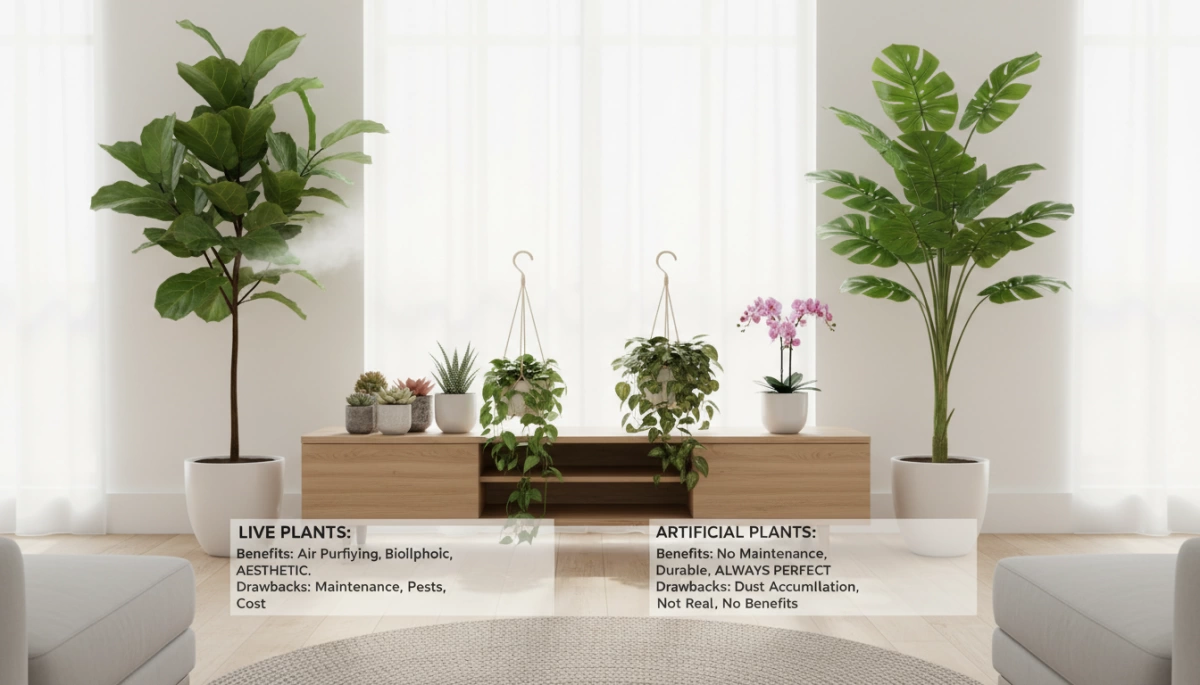
When I break down the debate between real and faux, it usually comes down to three distinct factors: aesthetics, money, and location. Let’s be real—plant parent burnout is a valid reason why so many homeowners are switching sides. Here is how the two actually stack up against each other, with insights from real users.
Aesthetics: Permanent Peak Bloom vs. Seasonal Withering
The biggest advantage of faux foliage is consistency. With a live flowering plant, you might get two weeks of beautiful blooms followed by months of drooping leaves and dormancy. Artificial options offer permanent botanicals that stay in peak condition year-round. You don’t have to worry about brown tips, dropped petals, or seasonal sadness. A Philadelphia college grad with a “black thumb” said: “I kill plants too easily, but my highly realistic artificial plants look perfect all year—no more guilt about wilting greenery.”
For example, you can keep artificial silk lilies looking pristine on your dining table without ever changing the water or dealing with pollen mess. It’s about achieving dynamic aesthetics without the biological clock ticking against you.
Cost Analysis: The True Price of Greenery
Many people assume high-quality fake plants are too expensive upfront, but the long-term math tells a different story. Live plants operate like a subscription model—requiring fertilizers, pest control, repotting soil, and replacement costs when they inevitably die. A Cleveland homeowner who uses budget-friendly faux hacks said: “I get cheapies at Old Time Pottery and cut them up to make custom compositions—way cheaper than replacing dead live plants every few months.”
| Feature | Live Plants | Artificial Plants |
|---|---|---|
| Initial Cost | Low to Medium | Medium to High (for highly realistic artificial plants) |
| Maintenance Cost | High (Soil, food, pots, water) | Budget-friendly (Zero recurring costs) |
| Lifespan | Unpredictable | Years (Decades for UV resistant artificial plants) |
| Resale Value | None (usually compost) | Retains value as home decor |
Placement Freedom: No Light? No Problem
This is where artificial greenery truly wins. I can place a fern in a windowless bathroom or put a fiddle leaf fig in a dark corner of the living room, and they will look perfect. You are not bound by the sun. low light indoor plants in the live world often struggle to grow, becoming leggy and sad. A Houston nurse who works night shifts said: “Some rooms don’t get indirect sun so shade-tolerant faux plants are my only option—and they look just as good as real ones.”
With faux options, you get shade-tolerant decor that fits anywhere, from high shelves to basement offices. You can even use artificial grass and plastic flowers to create a lush plant wall in a hallway that receives zero natural light. It opens up your entire home to biophilic design without the environmental limitations.
- Pet Safe: No toxic leaves for cats or dogs to chew on—an Denver marketing specialist with a golden retriever confirmed: “I have lots of live plants, but in places my dog can reach I have a few fake ones to keep him safe.”
- Hypoallergenic: No mold spores or pollen triggers—perfect for allergy sufferers like the Miami IT professional.
- Maintenance-free: Set it and forget it—ideal for busy travelers like the Chicago sales manager.
How To Style Faux Greenery Without Looking Fake
The difference between a tacky plastic plant and a convincing botanical display often comes down to how you style it. Even the highest quality permanent botanicals need a little human touch to settle into a space. We treat faux foliage just like interior design elements; they require proper placement and staging to fool the eye. Here is how we elevate artificial plants from “fake” to botanical accuracy, with tips from real users.
The Potting Hack: Never Leave It in the Starter Pot
Most artificial trees and floor plants arrive in a small, weighted black pot. This is merely a “grower’s pot” designed for stability during shipping, not for display. Leaving a plant in this tiny base is the quickest way to ruin the illusion. To achieve professional interior landscaping, you must “repot” the item—a tip a Dallas event planner swears by: “I never leave faux plants in their original pots; a nice ceramic container makes all the difference.”
- Choose the right vessel: Drop the starter pot into a decorative planter, woven basket, or ceramic container that fits your room’s aesthetic.
- Scale matters: The new pot should be slightly larger than the starter base to provide balance. For instance, placing a realistic artificial Monstera Deliciosa in a substantial mid-century stand instantly makes it look established and intentional rather than temporary.
Top Dressing Secrets
Once your plant is in its decorative container, you need to hide the mechanics. If you can see the plastic base or styrofoam anchor, the magic is gone. We use a technique called “top dressing” to mimic a real planting environment—a trick a Pittsburgh allergy sufferer uses to make her faux plants look real: “Covering the base with river stones makes it look like it’s actually planted in soil, and no one suspects a thing.”
- Natural textures: Cover the base with dried Spanish moss, smooth river stones, or even real dirt.
- The visual trick: When the brain sees organic texture at the root level, it assumes the rest of the plant is real. This simple addition adds weight and realism to maintenance-free greenery.
Shaping and Fluffing for Biophilic Silhouettes
Out of the box, artificial plants are compressed to fit into narrow cartons. You have to act as the gardener to bring them to life. Most high-end stems feature wire cores that allow for manipulation—a Chicago architect who’s used Ndi.com faux plants for 8 years said: “Bending the branches to mimic natural growth makes even large UV resistant artificial plants look authentic.”
- Bend and curve: Gently bend branches outward and slightly downward to mimic the effect of gravity. Real branches rarely grow in perfectly straight lines.
- Create asymmetry: Avoid perfect symmetry. Nature is imperfect. Turn leaves toward the “light source” (your nearest window) to create dynamic, biophilic silhouettes. Even sturdy outdoor options, like a UV resistant faux pine tree, benefit from having their needles fluffed and branches spread to look lush and full.
Hygiene Maintenance
While you don’t need to water these plants, you do need to keep them clean. Real plants don’t accumulate thick layers of dust because they are organic and often wiped down or rained on. A dusty artificial plant looks dull and obviously fake—a Pittsburgh allergy sufferer noted: “Fake plants require maintenance, too, because they get dusty, but it’s way easier than watering and fertilizing real ones.”
- Dusting routine: Use a microfiber cloth or a can of compressed air to remove dust from broad leaves and crevices.
- Shine retention: Keeping the leaves dust-free preserves the color depth and sheen, ensuring your home decor trends 2026 remain fresh and vibrant without the hassle of pest control or watering schedules.
Where Faux Plants Shine Best
Sometimes, the environment just doesn’t support organic growth, or the logistics make it impossible. In these scenarios, high-quality artificials aren’t just a substitute; they are the superior choice for interior landscaping—as real users across different lifestyles have discovered.
Commercial Plantscaping and Offices
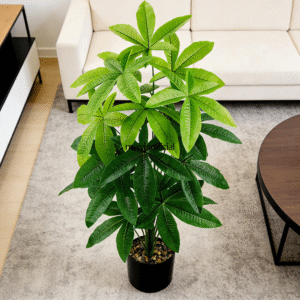
In the corporate world, consistency is part of the brand. You can’t have a dying ficus greeting clients in the lobby. Commercial plantscaping relies heavily on maintenance-free greenery to ensure the office looks professional 24/7 without adding a gardening service to the overhead. A robust money tree pachira aquatica guiana chestnut is a favorite for executive suites because it symbolizes prosperity and maintains its structure without shedding leaves on the conference table. An Atlanta social media manager added: “Our office uses highly realistic artificial plants—no one has to stop working to water them, and they always look perfect for client meetings.”
Vacation Homes and Rentals
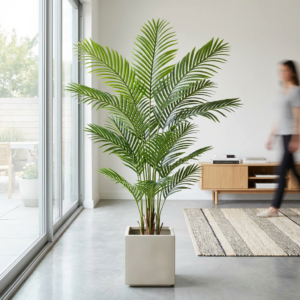
For Airbnb hosts and vacation home owners, the “set and forget” factor is crucial. You cannot rely on guests to water plants, nor can you visit daily to tend to them. home decor trends 2026 heavily favor permanent botanicals in rental properties to avoid “plant parent burnout.” A Boulder freelance writer who rents out her cabin said: “I use a faux palm tree in the living room—it withstands variable temperatures and always looks like the listing photos, no matter who stays there.”
- Durability: A faux palm tree can withstand variable temperatures when the AC is turned off between guests.
- Visual Impact: It guarantees the property looks exactly like the listing photos every time a guest checks in.
Allergy-Free Zones
One often overlooked downside of live plants is the soil, which is a breeding ground for mold spores and bacteria. For medical offices or homes with severe allergy sufferers, hypoallergenic plants are the only safe option. By using faux foliage, we eliminate the risk of respiratory irritants while still achieving the calming effect of biophilic design. The Miami IT professional with asthma said: “Faux plants are the only way I can have greenery in my home without triggering my asthma—no more moldy soil or pollen, just clean, beautiful greenery.”
Frequently Asked Questions About Artificial Plants
Do artificial plants make a house look cheap or tacky?
Absolutely not, provided you choose quality over quantity. The “tacky” reputation comes from outdated, shiny plastic versions that scream fake from a mile away. Modern home decor trends 2026 focus on biophilic design using high-end artificial trees and plants that are indistinguishable from the real thing. If you invest in botanical accuracy, your space will look sophisticated, not cheap. It is often better to have one high-quality faux olive tree than ten cheap-looking plastic ferns—a New York interior design consultant admitted: “I used to hate faux plants, but the new manufacturing grade quality options look so real, I use them in client homes all the time.”
What are the best materials for realistic faux plants?
To achieve that lifelike look, you want materials that mimic the natural texture and weight of foliage. Real touch technology—often using latex, silk, or high-grade polymers—is the gold standard. These materials capture the irregular veins and color gradients found in nature. For instance, high-quality artificial hanging vines use advanced molding to replicate the waxy feel of real leaves, ensuring they drape naturally rather than looking stiff and manufactured. A Dallas event planner who uses LDF Silk faux plants said: “The texture of these plants is so realistic, even when you touch them, you think they’re real.”
How do I clean high-end artificial trees?
One of the biggest perks of maintenance-free greenery is how easy it is to clean. You don’t need special chemicals—a Pittsburgh allergy sufferer shared her simple routine: “I dust my faux plants weekly with a microfiber cloth, and use compressed air for the hard-to-reach spots. It takes 5 minutes and they look brand new.”
- Dusting: Use a feather duster or a microfiber cloth weekly to prevent buildup.
- Compressed Air: For intricate branches or faux foliage with tight leaves, a can of compressed air works wonders.
- Wiping: For larger leaves, a damp cloth (water only) removes stubborn grime. Avoid harsh detergents that might fade the UV coating.
Are faux plants safe for cats and dogs?
Yes, this is a major reason why pet owners switch to permanent botanicals. Many common houseplants like lilies, sago palms, and philodendrons are highly toxic to pets. pet safe greenery in the form of artificial plants eliminates the risk of poisoning entirely. You get the lush aesthetic without worrying about your cat chewing on a toxic leaf or digging up moldy soil. Just ensure the plant is sturdy enough that a playful pup won’t knock it over—an Avet technician confirmed: “My cats chew on my faux plants all the time, and I never have to worry about them getting sick. It’s the best of both worlds.”
How we support you:
🌿 Performance: 98% Highly realistic, low maintenance, no watering, no seasonal damage.
🛡️ Safety: Fire Retardant & UV Resistance options to meet strict commercial codes.
🏭 Capability: OEM/ODM custom designs with Flexible MOQ supporting projects of all scales.
Looking to elevate your next landscaping or interior project? Connect with us for a consultation. At Meiyi, we specialize in providing high-end, realistic greenery solutions tailored for both residential and commercial real estate.